
“Reaching Out” Concert at Boyer
By: Annika Verma
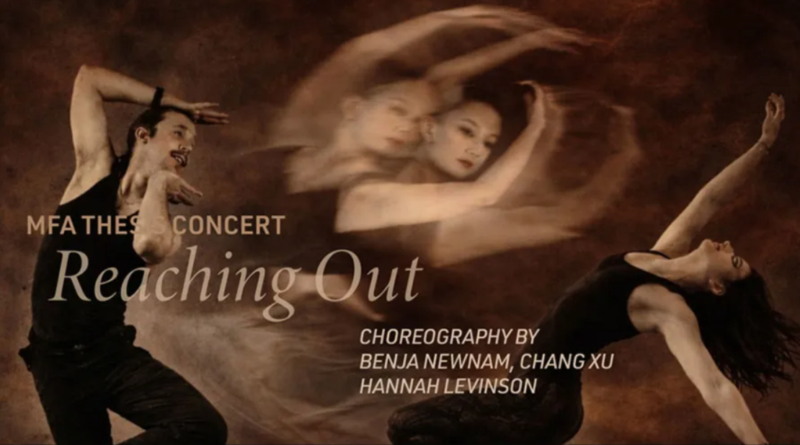
On Friday, February 20th and Saturday, February 21st, the Spring MFA Thesis Concert I: Reaching Out, featured choreography from MFA students: Benja Newnam, Chang Xu, and Hannah Levinson. Boyer College of Music and Dance hosted the 90-minute event. Audience members were welcomed with detailed pamphlets, soon-to-be-deciphered notes, and non-program music that clicked wonderfully in the ears.
Newnam’s choreography opened the 90-minute program with a clear focus on narrative and message. As audience members filed in, they picked up indiscernible notes and were treated to an answer key on the projection before Newnam’s program officially began. While dancers displayed Newnam’s choreography, viewers could notice a narrative taking place as dancers mirrored each other, exchanging written papers like the ones given to audience members. They even interacted with the audience by providing them with coded notes.
Newnam’s piece is congruently titled “Read It Back to Me,” affirming the storytelling, sharing, and interaction found in his work. Temple University’s MFA program allowed Newnam to commit three years to “investigating its [dance’s] relationship to storytelling and community building,” says Newnam in the concert pamphlet.
Immediately after, student Chang Xu presented her program titled “Foreign Princess” and appeared as a central dancer in her choreography. Her piece began sonically soaked in Chinese music and dress. This performance gradually transformed into American-style dance and dress with a ballet sequence. A transitive experience between Chinese and American cultures appeared in the middle of the sequence. The Chinese dancer finds American dancers running around and away from her, signifying the initial disconnect felt as this “Foreign Princess” lands in America.
Xu’s favorite part was the synchronized dance at the end of the modern, American dance segment because, “At that moment, the body is no longer in a state of conflict or struggle, but a state of freedom after integration. The audience can see the flow and balance of yin and yang in Chinese culture, as well as the extension and tension brought by Western dance training,” she says. Xu notes that the movements in this segment are open and expansive— “it gives me a feeling like sunshine—warm, bright, and brilliant,” he adds.
An integral auditory aspect of Xu’s program was her voiceovers, both prefacing the piece and following the narrative throughout. Xu explained that these voice-overs were pre-determined and crucial. As Xu says, “the entire [program] itself is a very clear narrative of a specific stage – from being in China, to the journey in a foreign land, and then to the integration of body and culture. These voice-overs allow the audience to follow the changes in the body and enter each stage.”
After the intermission, Hannah Levinson’s piece, “The Aftermath,” began. Her choreography focused on diverse reactions and expressions of trauma. Levinson explains, “Through my research, I investigated the idea that there tends to be certain emotional expectations in response to tragedy, which can make it harder for those who don’t fall under that category of ‘healthy ways to react.’”
This processing of trauma was shared not entirely through facial expressions, but through transforming each dancer into the physical representations of the diverse trauma responses. “For instance,” Levinson adds, “some people often have a harder time understanding those who disassociate, due to the misconception that this person is unaffected by this event.” Certainly, Levinson’s piece featured precise movements and even sound—a visceral scream as an expression of pain, to physically embody the harm that gun violence, particularly in a school setting, can have on both minds and bodies.
Similar to Newnam’s choreography, Levinson’s program featured a sense of connectivity, mirroring, and isolation. Here, Levinson’s goal was to display the expectations and instability of wanting to grieve and process trauma communally while also desiring to navigate it on one’s own. In the end, this push-and-pull process might leave the person feeling isolated. “I would say,” adds Levinson, “that navigating the difficult contrast between unity and isolation was most important in the development of this piece.”
The program ended after Levinson’s choreography, in which she was a last-minute dancer.
Newnam, Xu, and Levinson spent years creating and refining their choreography through Temple University’s MFA program. Their pieces, being around 30-minutes each, are the culmination of their mental, physical, and emotional dedication to their craft.
This concert was the first of two in the Spring MFA Concert Series. The second concert will be on Friday, March 13th, and Saturday, March 14th, and will feature choreography by Olivia Mohsen Alsamadi, Yihang Li, and Esmeralda Luciano.


