OPINION: ICE OUT Pins at The Grammys
By: Annika Verma
Following the murders of Renee Good and Alex Pretti in Minneapolis, Minnesota, activists across the country have organized protests, vigils and walkouts.
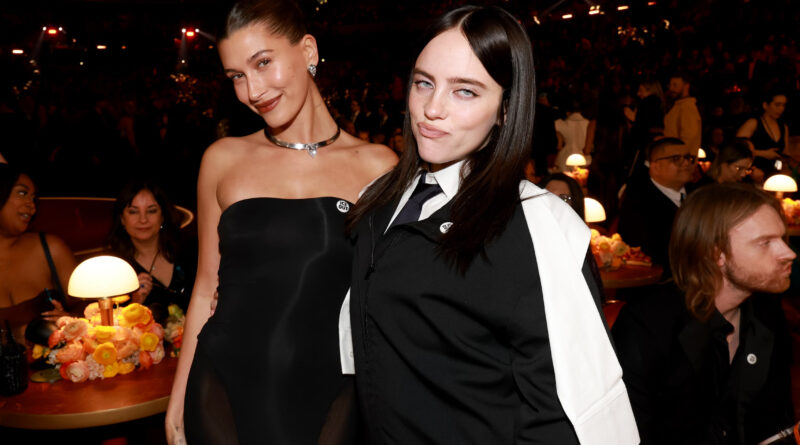
The 2026 Grammys took place with prominent celebrities accepting their awards as confirmation of their talent and hard work while using their spotlight time to condemn ICE and send hope to immigrants across the nation. However, an interesting form of activism came from celebrities like Billie Eilish, Hailey and Justin Bieber through their quarter-sized, black-and-white “ICE Out” pins on their chest.
This form of advocacy closely resembles the casual awareness of college students, who wear pins on their jackets to quietly display their political stance. For celebrities, the use of such a minuscule pin at a monumental event appears incongruous and slightly comical.
The pins created by activist groups, like the Working Families Party, as part of the Be Good-ICE Out campaign, featured larger sizes than the ones predominantly seen on television for the Golden Globes and the recent Grammys. “The size demotion is explained by guidance from celebrities’ stylists as a way to accommodate their clothing.” says Nelini Stamp, director of strategy for working families power.
Stamp expands on the visual accommodation for celebrities, saying that “We want to be respectful” — “Folks choose their outfits sometimes months before.” The size alteration, while hoping to spread the ICE Out message among more celebrities, ultimately only minimizes its impact in the name of fashion and status.
The small size of the pins mirrors the dimensions of Chappell Roan’s prosthetic nipple coverings and rings, thereby undervaluing the ICE Out message and demoting the pins to the level of an accessory rather than a sincere, searing political message. Certainly, the pin’s coin-sized nature can be too easily compared to the size of an earring or brooch, reducing its political monetary value.
The most marketable images of celebrities wearing the two-toned pin are those whose outfits mirror the black-and-white colors of the pin, like Hailey and Justin Bieber, Billie Eilish and Finneas, Kehlani, Amy Allen, and Mark Ruffalo. This way, the pin blends in with or perfectly contrasts with their outfits, thereby enhancing their fashionable, celebrity status and allowing the pin to go unnoticed or be seen as a supplement to their celebrity.
Stamp explains that “We need every part of civil society, society to speak up” — “We need our artists. We need our entertainers. We need the folks who reflect society.” Although Stamp’s statement accurately captures what many anti-ICE Americans believe, the size compromise dilutes the message so that the pins are “barely legible on TV screens” according to the New York Times. The power of a pin, especially one so small, is minimized by the largeness of the celebrity’s persona and is similarly drowned in a sea of notable people.
Activism, particularly on a meticulously planned night like the Grammys, must be doubtlessly discernible. Puerto Rican rapper and singer, Bad Bunny, made this explicit, committing his award speech time to an exacting message: “Before I say thanks to God, I’m going to say ‘ICE out’” — “We’re not savages, we’re not animals, we’re not aliens. We are humans, and we are Americans.”
Bad Bunny’s message differed from the pins in that his announcement was substantial and confident, and while a pin cannot carry the same power as a spoken speech, it can leverage its unique property of size by choosing to be large. Bad Bunny did not wear an “ICE Out” pin.
Ultimately, compromises like this must stop occurring when it comes to massive opportunities like advocating for anti-ICE approaches and ideology during a critical, fatal, and fertile time in our nation’s history. The sentiment that something is always better than nothing is true, but when will we stop including multi-millionaires and their alleged pre-destined collaboration with Gucci to stand between an ICE Out slogan and people watching at home?
The compromise and understanding must stop coming from advocacy organizations and instead come from celebrities and their teams by permitting larger, unapologetic displays of solidarity, even if it covers the shiny gems of their gown.
A large, unrelenting advocacy can rarely be ignored, and we cannot waste more time on small easy methods, when there are countless opportunities to be bigger and bolder.