
A Clockwork Orange: How my High School English Teacher Changed the Way I Appreciate Media Forever
Normally I review concerts for the WHIP website, but I was driven to write a movie review because I wrote a Letterboxd review that went above and beyond my typical funny one-liners. I figured none of my mutuals on Letterboxd would be interested in the congested contents of my brain, so I wanted to expand on my lengthy review. My admiration for this film upon second viewing was reevaluated upon my recent reading of the original novel. I had too many comments and thoughts to simply keep in my brain without having it all spill out through my fingers typing on my Notes app. This intricate way of processing the film was thanks to my high school English teacher.
In my sophomore year of high school, my honors English teacher, who would then go on to be my AP Lang teacher the following year, had us read Anthony Burgess’s A Clockwork Orange at the end of the school year. This teacher had a reputation for giving out irritating 5-question reading quizzes with the most specific questions known to man, ones that you couldn’t cheat your way out of reading by glancing at the Sparknotes or watching the film adaptation. I had generally kept up with the reading but experienced some burnout towards the end of the school year and thought I could get away with just watching the movie to replace reading the last section of the book. This did not work. I’m pretty sure I landed a solid 25% on the last couple quizzes.
My classmates and I were fed up with the difficulty of the quizzes forcing us to actually read the book. They were seen as torture struck by a teacher who enjoyed inflicting pain and drinking the tears of his struggling students. It wasn’t until after I re-watched the film after finishing the novel to truly treasure and value his teaching approach. I am appreciative of being able to take in the book in its entirety by a teacher who taught in such a meticulous and engaging way. These quizzes were given for a reason. I came to appreciate how deeply reading comprehension can strengthen one’s understanding of different types of media.
I was eager to forget most of my experiences throughout four years of high school, but A Clockwork Orange followed me. I was inspired to rewatch this movie in the first place after seeing an abundance of edits of the opening scene and admiration of the score on my Instagram explore page for whatever reason. At the time of my first watch, I remember appreciating the film’s aesthetics and Stanley Kubrick’s approach on transforming Anthony Burgess’s dark themes into an engaging commentary on the intentions of humanity. It was a good movie, but forgettable at the time. However, during my second watch years later, I had fallen into a trance once again upon hearing the score and being forced to stare into Malcolm Macdowell’s perfectly mascara’d eye. I was brought back into the cold, rigid desks in my English class. This was over three years ago, and I had remembered what every single unconventional word used by the core four characters meant. Droog, chelloveck, viddy, gulliver, nochy, appy polly loggies; I feel like a human glossary.
The main reason why my English teacher was so passionate about this book was due to his admiration for Burgess’s Nadsat, this fictional language heard throughout the movie. Burgess digressed from using modern slang as he knew it would appear dated and unserious to the generations after him who would read this book. He had made up parts of a new language, mostly composed from Russian with some English components. I’m not here to write a transcripted linguistics lecture, but if you found yourself getting frustrated with not being able to understand the way Alex DeLarge spoke with his “droogs”, I recommend doing a deep dive on Burgess’s fascinating mind and intentions from building the language of Nadsat. It won’t have the same effect as my English teacher, but you’ll be blown away with interest just the same.
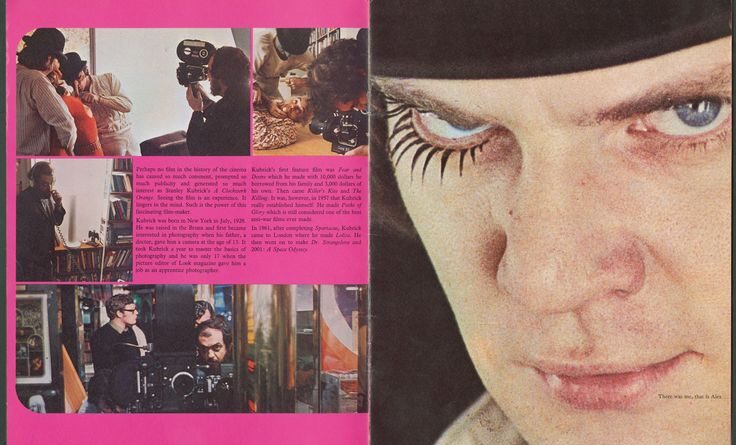
I do believe the book to be miles better than the movie, as there are certain elements that could have only been effectively conveyed through literature rather than a visual adaptation. However, Kubrick tackled the difficult task of depicting this piece in the best way one could have. The score could not have been chosen in a more immersive manner, those synths will always be engraved in my brain. The color palette kept me entranced the entire time. Malcolm Macdowell was a perfect casting choice (even though I was distracted in a couple scenes because he looked like Crazy Frog). That cold stare, those blistering eyes, that sinister voice, that body language, all while being creepily charismatic to get what he wants was exactly how I envisioned Alex to be.
While scrolling through Letterboxd reviews from over 50,000 people, the main criticism of this movie is for being too graphic. This is inevitable and an acceptable take. Obviously, no one enjoys seeing rape or vicious beatings, especially so early in a movie.This further strengthens my argument of the story working more as a book, as the violence was definitely more detailed, gruesome, and increased in book form. While this is simply my opinion, I believe that watching violence is harder to take in than reading violence, no matter the extent. I completely understand why this wouldn’t be the average person’s preferred thing to watch, but it was unfortunately necessary in Alex’s characterization. If the consumers weren’t exposed to his immense lack of mercy and remorse in full throttle, we wouldn’t be able to effectively build his psyche, which is essential because the story explores the age-old question if humans can be rehabilitated from previous horrid ways.
I will say that one part of the movie adaptation I prefer to the book is the omission of the last chapter, which features a time jump where Alex runs into one of his former droogs, who has grown away from his life of sociopathy and crime. This makes Alex reflect on the lack of growth he’s made in his life, and slowly starts to change his ways. Personally, I found that last chapter to appear quite rushed, like Burgess was going out of his way to answer the dilemma of whether people can change. However, when considering that there is both a book and a movie adaptation, I see A Clockwork Orange to be an interesting commentary on both sides to this still-unanswered question.
If my opinion means anything, I would say that there are a number of factors that depend on the extent of how “bad” a person was before the rehabilitation attempt. “Bad” behavior is a spectrum. For instance, someone can be rehabilitated if they grew up with kleptomaniacal tendencies, not homicidal tendencies. This isn’t a biology or psychology class so I’m going to refrain from doing an immense deep dive, but I mean to say that Alex could have never been saved. He was wired badly, which is unfortunately a rare malfunction in the genetic process that just can’t be fixed. Even though I got a 2 on the AP Lang exam, I will apply what I learned from those experiences forever.

