REVIEW: Emma’s Nov. 2025 Movie Reviews
WRITTEN BY: Emma Booth
As a lover of movies and one of the hosts of Film Maniacs on WHIP (catch us Wednesdays at 8 p.m.), I’m always interested in dissecting new movies, whether they are new to the world or just new to me. In November, I checked some movies off of my Letterboxd watchlist once again, leaving either the theater or my living room in confusion, disappointment or tears.
*Spoiler alerts ahead*
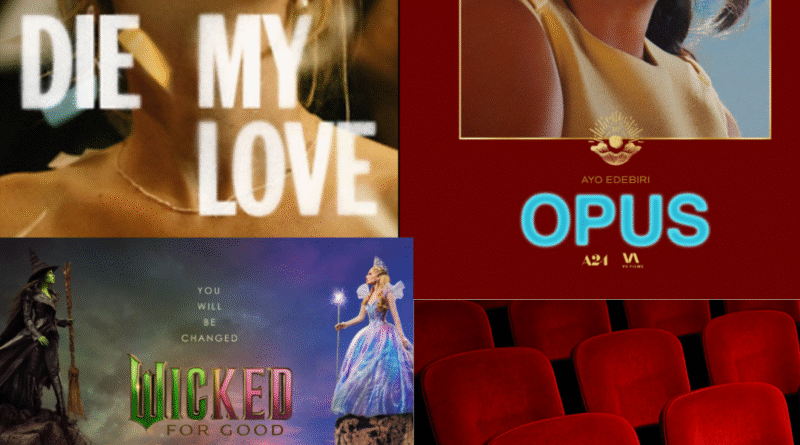
Die My Love (2025) – Lynne Ramsay: 4/5
Adapted from Ariana Harwicz’s 2012 novel of the Spanish title, Matate, amor, this black comedy drama film starring a debuting partnership of A-listers Jennifer Lawrence and Robert Pattinson will definitely leave you confused but moved as its conclusion, and you may not exactly understand why.
Young mother Grace (Lawrence) is slowly slipping into insanity as she attempts to build a life with her husband Jackson (Pattinson) in their new home in Montana, left to them by Jackson’s recently deceased uncle. Grace’s increasingly irritable and erratic behavior leaves Jackson helpless. Grace and the audience alike struggle to understand what is real life and what is a psychosis-induced hallucination.
Scenes cut back and forth during Grace’s pregnancy and shortly after she gives birth, a confusing choice that is somewhat hard to follow. Then again, a lot of this film is hard to follow, although it is conscious of its ambiguity. Details about Jackson and Grace’s livelihood are never fully divulged. We know Jackson works late hours and has a long drive from home, and Grace is a writer. It is never said exactly if she has made a career out of her writing; we don’t know what she writes or has written, or whether she has been published. We know that Jackson’s work has made Grace’s existence revolve solely around the child, with no indication of any ambition or passion besides her writer’s block.
The biggest hole in the film are some of these details. It’s hard to root for a couple that you know nothing about and without a backstory. It’s hard to understand what brought this couple together and why they stay despite the hardships. Ramsay’s use of hard-hitting emotional scenes between the couple, as well as just Grace with jarring sounds and the vibrant filter and visuals, make for an intense watch that is hard to look away from.
The sound design and profile are done exceptionally well throughout the movie, an element that adds to the overall sensory intake we get. The sounds of nature in this rural setting we are put in are exacerbated, meant to be felt how Grace feels them, with the buzzing of flies at an all-time high at any moment outdoors. Dogs barking, babies crying, people murmuring and talking are paired with cinematography that builds on our sensory discomfort with shaky movement and uncomfortably close shots.
This film doesn’t tell you what to think, but shows you an experience of motherhood, marriage and livelihood that you are meant to interpret for yourself. It invites you to feel the intense and raw frustration, grief, and depression that are often byproducts of motherhood and not represented very often by mainstream media, which I found quite beautiful. While it feels overstimulating to watch Grace be pushed or seemingly push herself to the brink of lunacy, that is meant to be the antithesis of the film.
Jennifer Lawrence’s performance is incredible, just like every other film she’s in. It’s no surprise that Lawrence will draw you into a story, but the highs, lows and complexities that this character requires really show her range and dedication to a scene. It shows similarities to her character in Mother!, both requiring extreme physicality.
This film has a lot hidden within the lines that could be dissected for hours on end, but it also leaves a lot unanswered, some for good reason and some that we could’ve done with more of. There is definitely a lack of foundation to hold onto within Grace’s mental state, her motherhood and their relationship, because we can’t see what is necessarily being lost – what the stakes are for them. However, the performances of both Lawrence and Pattinson bring such a human story to these abstract characters that is worth appreciation.
Opus (2025) – Mark Anthony Green: 2/5
The debut film for writer and director Mark Anthony Green and debut lead for rising star Ayo Edebiri (The Bear) premiered in late January at the Sundance Film Festival and was later released by A24 in mid-March.
I had high hopes for a lead debut with Edebiri and therefore, Green, but it pains me to say that this movie did not reach them. With a cliché plotline, lack of character development and confusing plotholes, Opus doesn’t truly convince you that it understands what it’s trying to say.
The title of the film implies a composition of artistic work, which in reality, is the calculated manipulation of crazed pop superstar, Alfred Moretti (John Malkovich) and his cult followers, the levelists. Budding journalist Ariel Ecton (Ayo Edebiri) accompanies her boss, Stan Sullivan (Murray Bartlett, The White Lotus), along with four other various media specialists to a release party at Moretti’s Utah compound for his first new album in 30 years. Ariel begins to notice strange happenings that accumulate into a climax where the guests fall victim to Moretti’s plan to sacrifice them.
If you are a frequent watcher of psychological thrillers, this plot is one you know well. This format of thriller has been popular for many years – a seemingly regular protagonist is taken to a new place where they don’t know many people, and weird things start to occur until they realize they are in danger and end up often being the sole survivor.
Popular films such as The Menu, Midsommar, and Get Out follow similar premises. The question is, when does it start to get old? The films aforementioned follow a typical blueprint but offer something new and captivating, well-received due to their striking effects, shocking gore or intriguing commentary. Opus makes this genre feel like it’s at its time, although it may just be an instance of poor execution.
Because of its similarities to these other classics, it’s impossible not to compare Opus to its psycho thriller sisters. Each choice made throughout the film has been done by other films in more interesting ways, which makes the work as a whole feel lackluster and almost satirical. The violence was not violent enough to be shocking and entertaining like The Menu, but not subtle enough to be creepy like Black Swan. The most visually scary and appealing scene was where influencer Emily emerges from the bean bag, writhing in pain with a completely swollen face, making it look like a supernatural monster of uncanny nature.
The character of Ariel is written painfully uninterestingly. We are given little to no backstory on her goals or aspirations and she never opens up to the audience, who remains somewhat of a mystery even at the film’s conclusion. Although she was obviously meant to be a pawn in Moretti’s game, she shouldn’t be a pawn to us as the lead character. It takes a real charming talent like Edebiri to make you appreciate her acting among the lines of dialogue that give her virtually nothing. Her physical acting is what stands out, especially towards the end of the film when we see dramatics that we aren’t accustomed to from her previous work. Edebiri is one of three elements in the film that keeps you watching.
The second is Malkovich, a generational talent who always brings something special to each project he is in. He keeps things interesting by creating the right amount of suspense and keeping the audience guessing what he was going to do in any given scene. A complicated and nuanced character needed a complicated and nuanced actor, and he was the right man for the job.
The third is the cinematography and overall look of the movie, which was noteworthy for many reasons. Firstly, the set was incredibly constructed. Props such as the puppets made for the Billie Holiday puppet show were impressively artistic, although it was unclear what they actually represented. The color grading was perfectly warm and cool at the right times and the blue tones made for especially pleasing visuals.
There were many compelling shots and director choices throughout the film. The opening credits scene shows a back profile of Moretti in his prime and an array of spotlit fans dancing in slow motion individually, which successfully illustrates the dedication and love of this fanbase as a solid introduction. Another unique shot was a scene where Ariel is ambushed by a levelist in the bathroom of Moretti’s childhood home and we only see the front of the door, hearing the conflict on the inside without actually seeing it.
It feels like Green has something interesting to say as a former editor of GQ magazine with sensationalist journalism, fandoms, cult followings, and celebrity culture in general, but Opus did not translate a genuine message across the screen, but instead felt like it was begging for attention and creating scenes intended to shock and create controversy without any actual substance.
Wicked: For Good (2025) – Jon M. Chu: 3.5/5
The highly anticipated sequel to Wicked, released last November, is no doubt the current movie of the season, a story that has been in the works for over 100 years and stamped in the popular zeitgeist. The film is the second part of the beloved Stephen Schwartz musical, Wicked, set to screen, which is loosely based on Gregory Maguire’s 1995 novel Wicked: The Life and Times of the Wicked Witch of the West, a fiction written in the universe of L. Frank Baum’s 1900 novel, The Wizard of Oz.
A story like Wicked is one of extreme political importance while being told in an easily entertaining and accessible fantasy format. Although there were choices that could’ve been improved upon and a lack of luster that the first movie brought, the film ultimately delivered. The decision to divide the musical into two films may seem like an excessive monetization decision, and devoted fans of the tale may have some further complaints with the film adaptation. Nevertheless, Wicked: For Good proves itself in its attempt to create not just a movie, but an experience and a journey.
Following Elphaba’s defiance of the Wizard at the end of the first movie, she is stuck in a forest hideout, battling for animal rights after being branded as the “Wicked Witch” all throughout Oz.
Glinda becomes the spokesperson for the Wizard, known as “The Good Witch” throughout Oz, unable to ignore the political attention she is receiving. Madame Morrible creates a tornado that kills Elphaba’s sister, Nessarose (The Wicked Witch of the East) with Dorothy’s house and we then see the story of The Wizard of Oz play in the background as Glinda attempts to foil the Wizard and Morrible’s plans as Elphaba leans into her wicked label.
The film concludes with Elphaba faking her death by melting when Dorothy throws water on her, leaving Glinda to lead Oz and restore animal rights.
The way that Jon Chu creates a world of color and life is something especially exceptional to note. The Emerald City set was created with such detail, precision and beauty that the $150 million budget has to show for. The wedding scene is a remarkable display of floral perfection and shimmering decoupage that truly make your eyes water.
As Grande walks down the aisle of pink and green, golden butterflies adorn the room, each glisten catching your eye. This is how most of the set and colors pop on the screen. Not to mention the craftsmanship and respect to color theory that went into the costuming for each character. Glinda’s wardrobe is the closet of every little girl’s dream.
The story of friendship between the unlikely, sacrifice for the things and people you love and fighting for what’s right within the frame of a nostalgic and whimsical place like Oz transcends generational barriers and has a universal appeal.
Movies like Wicked and Wicked: For Good reprise the classics in a contemporary fashion, while commenting on real-world issues of dictatorship and freedom of governance masked by the make-believe world they are set in. We are forced to reflect upon the actions and history of our own civilization when we see the animals of Oz emigrating out of their home due to the discrimination they face.
For many minority viewers, this can be an emotional portrayal of their own experiences. What is the truth? It may not be based on facts or reason, but it’s what people agree on; which is a haunting reality for many to ponder.
Creating two parts to the Wicked story with two movies at a total of 4 hours and 58 minutes, it seemed that most of the plot was elongated through this second movie. As opposed to Wicked, which keeps a steady rise in conflict and plot development, there were moments of lull in Wicked: For Good that made for a less than graceful sprint to the finish line. When plot points aren’t going by way too fast, they are struggling to keep the audience engaged that makes for a clunky pacing structure.
The musical numbers in the second act of the broadway hit that the movie is depicting are arguably some of the lesser known songs. In the first act’s movie, each scene would build upon the world it was creating while making way for how to begin and end each musical number to where this film’s integration of music was a bit disjointed. The narrative was enriched the most because of emotional songs like “No Good Deed” and “For Good.”
Ariana Grande is a stand out actress and singer in this film, where Cynthia Erivo reminds us why she has one of the best voices to grace our screens. Grande specifically holds on to a bubbly charisma that she has mastered but balances it with the heavier emotional material that this script required.
Erivo is just as good as we remember, and it’s hard to go up from there. Jeff Goldblum as the Wizard is a home-run, with just the perfect amount of theatrics to make him manipulatively charming. However, while Michelle Yeoh has proven herself time and time again in each project she is a part of, this one feels a bit flat and it is apparently obvious that she cannot sing when paired with talents like Grande and Erivo that have phenomenal voices.
Ultimately, the ending of the movie brings us to an earnest conclusion, making a reference to the original broadway cover of Glinda whispering in Elphaba’s ear to create this full-circle moment. We have been given a tale of friendship that will be cherished for years to come taking us through hills and valleys of emotion that only the genius vocals of Grande and Erivo can produce. We learn that power can and should be used for good whether it’s magical or political. The question is: is there any more of this story to tell? I guess time and money will tell.